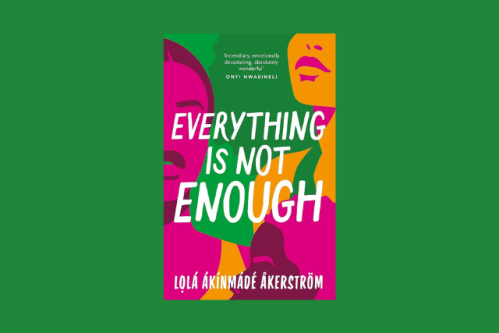
Everything is Not Enough is the sequel to Lola Akinmade Akerstrom’s widely acclaimed debut In Every Mirror She is Black, which followed the loosely intertwined lives of three very different Black women, Kemi, Brittany-Rae and Muna who are each begining new lives in Stockholm, Sweden.
The novel continues to follow these women as their lives further unravel. If you’ve not read In Every Mirror She is Black, then I strongly recommend reading that first as this book, picks up directly from the events that take place at the end of it.
The one who has it all
Kemi, a Nigerian-American marketing executive is the archetypal ‘woman who has it all’ – a high-profile career in one of Sweden’s top corporate brands, a loving and supportive boyfriend, Tobias, who demands nothing of her except to fully accept and reciprocate his love. Yet she is disatisfied, and as a result makes an alarmingly questionable choice in having an ill-advised affair with her married co-worker, Ragnar.

I found it really hard to follow Kemi’s story as it was more than a little frustrating to watch her lean into an affair which she admits did not serve her. Everything about their relationship made me so angry – Ragnar is arrogant, racist and an all-round ‘fuckboi’ to put it bluntly. Furthermore, all the cards – both professionally and personally – are stacked resoundingly in his favour, so Kemi literally has nothing to gain.
Yet, chapter after chapter Kemi indulges in a level of messiness which can only be described as some sort of self-punishment, as though on some level she doesn’t believe she deserves better, and let be real, has better in the person of Tobias.
I realise this sounds like a very harsh indictment, and I was taken aback by how exasperated I was. Then I realised I was triggered to some extent because I could relate to Kemi’s experience of being that one Black female face in a professional and/or even social environment and attracting the attention of that ‘one white man’ (Sisters, you know the one I’m talking about!). But having said that, it still felt like it all could have been avoided. Even more eggregious is the fact that her attraction to Ragnar seems to only be rooted in the power he exudes through his professional standing.
The one who realises that everything really isn’t enough
Brittany-Rae, a African-American woman is married to Jonny a multi-millionaire businessman, who incidently is Kemi’s boss. On the outside, Brittany appears to be blessed with a husband that is besotted with her and their child. But the reality is that Brittany feels increasingly smothered by Jonny’s love and longs for the person she used to be before him. Unearthing a few buried secrets about Jonny’s family and his past relationships forces her to face up to the reality of her marriage and make some important decisions for herself once and for all.
Brittany’s storyline was another exercise in patience. It felt like for at least half the book, she was just going in circles, with her frustration with her marriage, his family, her inability to speak Swedish, and everything else about her life.
There’s this element of entitlement and selfishness that both Brittany and Kemi manifest, which especially noticeable on the occasions when they interact with one another. Both of are quick to blame external forces for their respective dilemmas and problems, but neither seem to want to take some accountabilty for the situations they’re in until it’s almost too late.
The one who discovers how to thrive
Brittany and Kemi’s experiences are in sharp contrast to Muna, a young Somali refugee who at the end of the first book has attempted to take her own life. Though it appears that her story ends there, it’s picked up by her friend Yasmiin, a fellow Somali (and a minor character in the first book), who is named as her next of kin, and thus becomes a main character serving as the foil to the other two.
Shocked by Muna’s suicide attempt, Yasmiin vows to help her friend with her physical recovery and to come to terms with the overwhelming pain of her past. At the same time, Yasmiin is faced her own demons and must reconcile her own past in order to forge a path to her future.
Yasmiin’s story, and by extension Muna’s, was really powerful and riveting to read. I was so invested in her storyline in a way that I just wasn’t with Brittany and Kemi. I think this was in part because their respective stories were such a well trodden path, that from the outset I had a sense of how it would it end.
Yasmiin on the otherhand, is a working class woman who has very little at her disposal. However, she is a ‘grafter’, and although she is haunted and deeply ashamed of her past, it’s clear that every decision she takes is literally in the name of surviving.
With the little resource she has, her natural talent and street smarts, Yasmiin begins to create and build a life for herself – and one that is not reliant on her braggadocious husband, Yagiz.

Her upward trajectory demonstrates that having everything in world isn’t always what will enable a person to thrive in a society that doesn’t want to acknowledge their existence, much less their humanity, but sheer force of will and determination is.
I have very mixed feelings about this novel – I didn’t hate it, but I also didn’t love it. As well-written as it was in some parts, it also felt a bit disjointed in places. The ending was rushed and too neatly resolved, which jarred with the drama of first half of the book.
Had the novel just been about Yasmiin and Muna, and their survival against the odds, with Kemi and Brittany serving as minor characters, it would have been a much more enjoyable read.
 Just Read It