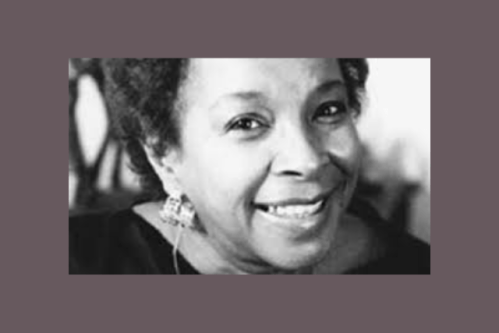
One of the first authors to significantly impact me in my preteen/teen years was the Trinidadian-American author Rosa Guy.
I loved her books because they were the few I had access to written by a Black author and centred on Black characters. It sounds wild, but this was the ’80s and early ’90s, and the UK school curriculum was not overly concerned with ensuring diverse reading lists.
But thank heaven for my local library (shout out to Lewisham Library), which widened my reading experience from being white middle-class centric to discovering stories about characters who looked like me. It was a profoundly foundational experience that undoubtedly shaped my reading habits for years.
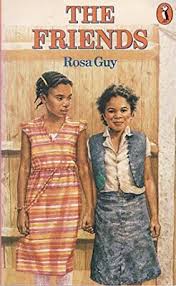
What I loved most about Rosa Guy’s books was that she didn’t shy away from the harsh social realities of her characters’ lives, such as the problems caused by drugs and poverty and raising questions about human potential and responsibility.
Her coming-of-age novels The Friends (1973), Ruby (1976), and Edith Jackson (1978), which focused on the friendships between adolescent girls, boldly confronted the intersecting issues of race, sex, and class.
Another trilogy, The Disappearance (1979), New Guys Around the Block, and And I Heard a Bird Sing (1987), centred on Imamu Jones, a Harlem teenager investigating various crimes in his neighbourhood. With a teenage boy as the main character in all three books, this trilogy specifically focused on the experiences of young Black men and boys in finding acceptance and belonging in a world that feared them.

Guy believed that young people deserved honesty and could handle the truth. Furthermore, she wrote with a passionate conviction that she had a message to share:
“I’m trying to raise the consciousness of young people because I believe that the future of the world is in the hands of young people. They are going to become the leaders of another generation. They need to understand it as fully as they can – the survival of the human race may depend on it.“
As a teenager, reading her novels felt like a lightbulb went off in my head—or like I had been given the answers to questions I didn’t know I had. I don’t remember discussing topics around race, sex, and class in any significant depth at school, nor did I have these conversations at home.
Rosa Guy was a gateway into discovering what life was like outside the bubble of school and home and what it could look like when even those places proved unsafe. It made me determined to understand the world and that everyone, regardless of background, has a stake in society.
I didn’t realise until now that Guy’s novels were based mainly on her personal experience, particularly of growing up with little or no support from family, which likely explains why these books created such a strong impression that has not left me some thirty years on.
Born in Diego Martin, Trinidad, in 1922, Guy’s parents immigrated to the US when she was five, leaving her and her younger sister behind with relatives. The sisters later joined their parents in Harlem, New York, in 1932.

Sadly, their mother died a year later, and their father later died in 1937, leaving the sisters to grow up in the foster care system. At age 14, she worked in a garment factory to support herself and her sister. At 19, she married and gave birth to her son a year later.
In 1950, Guy founded the Harlem Writers Guild with novelist John Oliver Kilens. It began as a workshop “to develop and aid in the publication of works by writers of the African Diaspora”.
The members included writers such as Maya Angelou, Audre Lorde and actors Ossie Davis and Ruby Dee. The Guild was very influential, nurturing more than half of all successful African-American writers between 1950 and 1971 who were associated with the workshop.
Although her books mainly centred on Black characters and were often concerned with Black consciousness and pride in being Black, Guy saw herself as writing for a universal audience, saying:
“I write for a world audience. I want to feel it’s a universal not specifically Black audience. I do believe that people are not that different. What helps one helps another and what destroys one destroys another.”
Rosa Guy died of cancer in 2012, aged 89 at her home in Manhattan, New York. Though most of her books are quite hard to obtain in the UK, her novels still resonate. Re-reading her work as an adult makes me overjoyed for my younger self to have discovered such a pearl of a body of work.
When asked if she was worried that people in power would not take her books seriously, Guy said,
“I think my books are taken seriously… Young people read and things of importance stick. I don’t think my books are easily forgotten.”
Sources:
https://www.britannica.com/biography/Rosa-Guy
https://www.theguardian.com/books/2012/jun/17/rosa-guy
https://booksforkeeps.co.uk/article/authorgraph-30-rosa-guy/
https://en.wikipedia.org/wiki/Rosa_Guy
 Just Read It