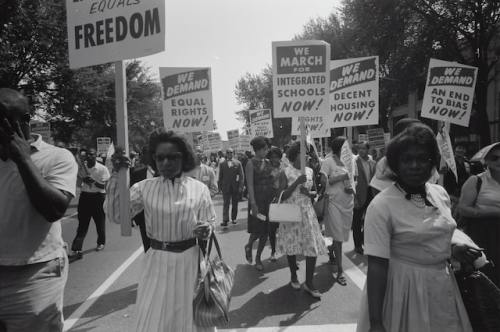
“During the civil rights movement, the church provided sustenance for us, helped us march on, helped generations of people confront some of the most vicious, violent acts”
Charlyne Hunter-Gault, former reporter New York Times
I think any conversation about soul music in the civil rights era, has to include some mention of gospel music and the role the Black Church as a driving force of the movement. Black churches were a unifying force for protesters, leading events with singing spiritual hymns and choir songs, as well as spearheading community-based campaigns.
An article in the New York Times noted that the power of gospel music gave people “new courage and a sense of unity”, and boosted morale by keeping “alive a faith, a radiant hope, in the future”, during the most difficult and trying times of protest and violence. Gospel music was integral to the civil rights movement as it was used at meetings, prayer vigils, Freedom Rides, in jails and other events, in the demand for social justice and change. Not only did gospel music unite the people, but it helped to forge identities and create art. And let’s not forget that was out of the Church that some of the most talented and legendary musicians in soul and RnB music would emerge.
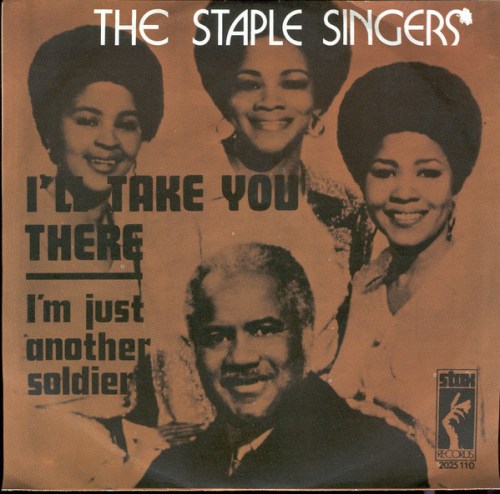
The Staple Singers were one such group, though they retained their gospel roots, fusing it with RnB, blues and soul. The group consisted of Roebuck “Pops” Staples, along with his children, Cleotha, Pervis, Mavis and Yvonne (who would replace Pervis when he was drafted into the US Army). The family began singing in Chicago churches in 1948 and by 1952 had signed their first professional recording contract. While on tour in 1965, the family saw images of the marches from Selma to Montgomery, which were attacked by the police with tear gas, clubs and dogs. In response, Pops Staples wrote ‘Freedom Highway‘, which marked their foray into the civil rights movement. Mavis later recalled, “My father wrote that song…for the big march from Selma to Montgomery, Alabama. We marched, we marched and we marched, and it ain’t over yet… I’m still on that highway and I’ll be there until Dr Martin Luther King’s dream has been realised.”
From there, the group became known for referencing civil rights and current social conditions in their songs, and always made a point of being both inspirational and motivational. Their 1972 hit, ‘I’ll Take You There’ with it’s uplifting lyrics and upbeat tempo is one example.
I know a place
Ain’t nobody crying’, ain’t nobody worried
Ain’t no smilin’ faces, mmm, naw, naw
Lyin’ to the races
Help me, come on, come on
Somebody help me now
(I’ll take you there)
The song first appeared on the album Be Altitude: Respect Yourself, and went to number one on both the Billboard R&B Singles chart and the Billboard Hot 100 chart. In the early seventies, America was knee-deep in the Vietnam War, and though significant strides in the civil rights movement had been made with the signing of the Voting Right Act in 1965 and the Civil Rights Act in 1968, there was still a lot of discontent, as people continued to fight for their rights and for equal opportunities. So it’s unsurprising that an optimistic song like ‘I’ll Take You There’ would make to the top of the record charts. That, and possibly the fact that depending on your mood, and how you like to interpret these things, the song sounds kinda sexual, especially with Mavis Staples’, earthy, husky and powerful vocals (sorry Auntie Mavis!).

‘Smiling faces, lyin to the races…’
The line “ain’t no smiling faces, lyin’ to the races”, references this idea of politicians and the like luring Black people in with their lies and false promises, and also reminds me of ‘Smiling Faces Sometimes‘ by The Undisputed Truth, which talks about backstabbing friends, which in turn reminds me of ‘Back Stabbers’ by the O’Jays. There’s probably a whole post to be written on why musicians of that time felt the need to be writing and singing with their entire chest about back stabbers, but that is for another time! Many have also interpreted the line, and indeed the whole song as describing an imagined world, Heaven, if you will, in which the civil rights movement has succeeded.
But my soul sisters and brothers, you will be fascinated, I’m sure, to know that this critically acclaimed song actually comes from a very tragic story. ‘I’ll Take You There’ was written by the Stax record label vice-president, Al Bell, after attending the funeral of his brother who was murdered. According to Bell, after he had returned from the funeral, he sat on the hood of a bus in his father’s backyard and began hearing the bass line, and the words. He then gave the song to the Staple Singers, who were signed to Stax at the time, and the song we all know and love was born.
Another fun fact is that bass intro comes from the instrumental reggae tune ‘The Liquidator‘ by the Jamaican band Harry J Allstars, which trust me you definitely will have heard before, and is also apparently very popular at football matches in the UK.
‘I’ll Take You There’ is one of those songs that will never get old and its timelessness and recognisability has cemented its place in music history. It’s considered one of the 500 Greatest Songs of All Time, according to Rolling Stone and was inducted into the Grammy Hall of Fame in 1999. Like many songs of that era, it has been covered and sampled within an inch of its life, most notably by Salt n’ Pepa in their 1991 hit ‘Let’s Talk About Sex‘ (see I was not lying about the sexual connotations!). I love it because it’s a happy feelgood song, and even though it’s written from a place of grief and sadness, it gives the listener something to hope for and look forward to. Something I think we can all agree is needed in our current troubled times.
Sources
Music during the civil rights movement by Vincent Triola
Songs a Weapon in Rights Battle by R. Shelton, New York Times (1962, August 20)
“I’ll Take You There”: Inspired by Murder and a Jamaican Riff by Chimesfreedom
500 Greatest Songs Of All Time by Rolling Stone
The Staple Singers – Wikipedia
I’ll Take You There – Wikipedia

